
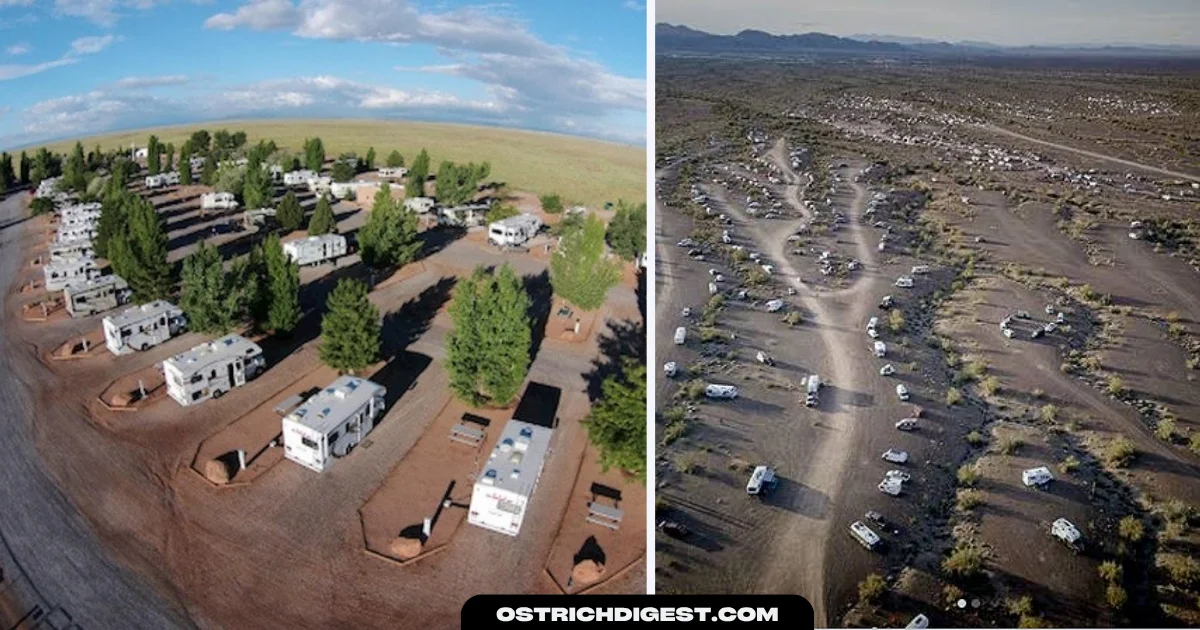
Every January, a tiny desert town with fewer than 4,000 year-round residents somehow hosts over a million visitors. Most of them arrive in RVs, set up camp on open desert land, and spend weeks hunting for gems under a relentless southwestern sun. Few of them stop to ask the one geographic detail that actually explains why this place exists the way it does: what is the elevation of Quartzsite, Arizona?
The answer matters more than it might seem. Elevation shapes everything about this town, from its scorching summer heat to its mild winter climate that draws snowbirds by the hundreds of thousands. This guide breaks down Quartzsite’s exact elevation, the terrain surrounding it, and why altitude plays such a defining role in the town’s identity.
What Is the Exact Elevation of Quartzsite, Arizona?
According to Wikipedia, Quartzsite sits at an elevation of 876 feet, or 267 meters, above sea level. Other geographic databases report figures within a narrow range of this number. City-Data lists the elevation at 878 feet, while USACitiesOnline places it at 879 feet. These small variations come from different survey points and measurement methods rather than any real disagreement about the town’s altitude.
For practical purposes, Quartzsite’s elevation rounds to approximately 876 to 879 feet above sea level. This is a relatively low elevation by Arizona standards. Much of the state sits considerably higher, especially in the central and northern regions where cities like Flagstaff and Prescott climb well above 5,000 feet.
Why Do Different Sources Report Slightly Different Numbers?
Elevation data depends on the exact coordinate point being measured and the survey technology used to capture it. NASA’s Shuttle Radar Topography Mission data, used by sites like Elevation.city, calculates elevation across a wider grid square rather than a single point, which can shift the number slightly. Meanwhile, official town coordinates measured at a specific civic location, such as Quartzsite’s town hall, may produce a marginally different figure.
These differences amount to only a few feet, which has no meaningful impact on climate, geography, or daily life in the town. Whether the precise figure is 876 or 879 feet, Quartzsite remains a low-desert community well below the elevation of most other notable Arizona towns.
| Elevation Data Point | Reported Figure |
|---|---|
| Wikipedia (Official Town Entry) | 876 feet (267 meters) |
| City-Data.com | 878 feet |
| USACitiesOnline | 879 feet |
| TopoZone USGS Map Data | 879 feet |
| Elevation.city (NASA SRTM Data) | 876 feet |
| Average Elevation Across Town Area | 936 to 945 feet |
Where Is Quartzsite Located, and How Does Geography Explain Its Elevation?
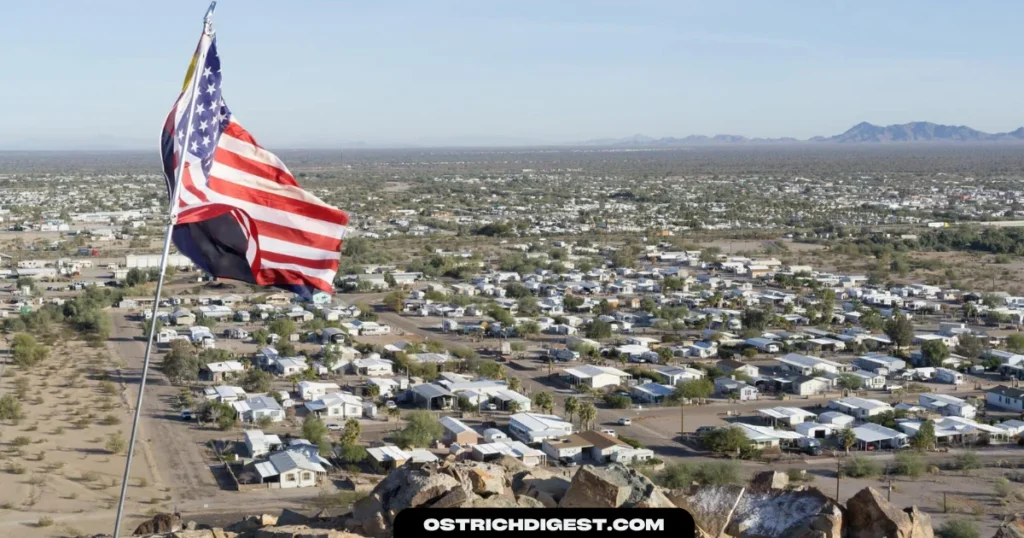
Quartzsite sits in La Paz County, in western Arizona, close to the California border. According to Wikipedia, the town’s coordinates place it at approximately 33.64 degrees north latitude and 114.23 degrees west longitude. Geographically, Quartzsite occupies a flat desert basin known as the La Posa Plain, which runs along Tyson Wash.
This basin location is the primary reason for the town’s low elevation. Surrounding mountain ranges rise sharply around Quartzsite while the town itself remains nestled in the valley floor below them. The Dome Rock Mountains overlook the town to the west, with Granite Mountain positioned on the southwest edge and Oldman Mountain to the northwest. Across the plain to the east, the Plomosa Mountains rise as another prominent feature of the regional landscape.
How Do the Surrounding Mountains Compare in Height to the Town?
The contrast between Quartzsite’s elevation and its neighboring peaks is striking. Cunningham Mountain, the highest point in the nearby Dome Rock Mountains, reaches 3,314 feet, according to Wikipedia’s entry on the range. That is nearly four times higher than Quartzsite itself. Middle Camp Mountain, further north in the same range, rises to 2,515 feet.
This dramatic elevation difference between the valley floor and the surrounding peaks creates the classic basin-and-range topography common throughout the American Southwest. Quartzsite’s low position in this geological pattern explains both its flat, accessible terrain and its intensely hot summer climate, since heat tends to settle and linger in low desert basins.
How Does Quartzsite’s Elevation Affect Its Climate?
Low elevation is directly connected to Quartzsite’s extreme summer heat. According to Wikipedia, the town has a hot desert climate, classified as BWh under the Köppen climate system, with mild to warm winters from November through March and intensely hot summers for the remainder of the year. Temperatures have reached as high as 122 degrees Fahrenheit, recorded on July 28, 1995.
Lower elevations generally trap more heat than higher ones because there is more atmosphere above to retain warmth near the surface. Furthermore, the surrounding mountain ranges can trap hot air within the valley basin, intensifying the effect. Quartzsite’s elevation, combined with its desert basin geography, produces summers that rank among the hottest anywhere in the United States.
Why Does the Same Low Elevation Make Winters So Mild?
Paradoxically, the same geographic factors that create scorching summers also produce comfortable winters. Daytime temperatures during the winter season in Quartzsite often reach into the 70s, according to RVBusiness’s coverage of the annual RV show season. This mild winter climate, paired with the area’s nearly desert-flat terrain, is precisely what draws hundreds of thousands of seasonal visitors to the region each year.
Quartzsite receives less than four inches of precipitation annually, according to DesertUSA. Combined with low elevation and minimal humidity, these conditions create one of the driest, sunniest winter climates available within driving distance of much of the western United States. Snowbirds searching for relief from snow and freezing temperatures find exactly what they need in this low desert basin.
How Does Quartzsite’s Elevation Compare to Other Arizona Cities?
Arizona has one of the most dramatic elevation ranges of any state in the country, and Quartzsite sits firmly on the low end of that spectrum. Phoenix, the state capital, sits at roughly 1,086 feet, already higher than Quartzsite despite both cities sharing a desert climate. Tucson sits higher still, at approximately 2,389 feet.
Northern Arizona cities climb dramatically higher. Flagstaff sits above 6,900 feet, putting it in an entirely different climate zone that regularly sees snow throughout the winter. Prescott, in central Arizona, sits around 5,300 feet. Compared to these cities, Quartzsite’s elevation places it among the lowest and hottest locations in the entire state.
Does Quartzsite Have One of the Lowest Elevations in Arizona?
While Quartzsite is not the absolute lowest point in Arizona, it ranks among the state’s lower-elevation communities. The Colorado River corridor running along Arizona’s western border, including areas near Yuma, dips even lower in places. Nevertheless, Quartzsite’s elevation places it solidly within the low desert basin category that defines much of western Arizona’s geography and climate.
This positioning along the western edge of the state, just 17 miles from the California border according to the Quartzsite Chamber of Commerce, places the town within a broader low-desert region that stretches across this part of the Sonoran Desert. The shared low elevation across this corridor produces a consistent climate pattern that residents and visitors throughout the region experience similarly.
How Has Quartzsite’s Elevation and Terrain Shaped Its History?
Quartzsite’s flat, low-lying terrain made it a logical stopping point for travelers long before it became a town. According to River Sands RV Resort, the location originated as a watering stop called Fort Tyson, or Tyson’s Wells, established in 1856 by settler Charles Tyson. Travelers crossing the desert toward California relied on this stop, and the flat basin terrain made it an accessible, navigable point along the route.
The discovery of quartz and other minerals in the surrounding mountains eventually gave the town its modern name and identity. A small mining boom revitalized the settlement, and it officially became known as Quartzsite in 1897, according to DesertUSA. Mining activity continued to define the town’s economy until 1965, when an entirely different kind of seasonal activity took hold.
How Did Low Elevation Terrain Enable Quartzsite’s Modern RV Culture?
The flat desert terrain surrounding Quartzsite, a direct result of its low elevation basin location, makes the area uniquely suited to large-scale RV camping. According to RVBusiness, the region includes thousands of acres of open, flat land, with roughly 11,000 acres managed by the Bureau of Land Management specifically for this kind of seasonal use. This terrain simply would not support the same scale of activity in a mountainous or steeply graded location.
In 1965, the Pow Wow Rock, Gem & Mineral Show launched what would become an enormous annual winter migration, according to DesertUSA and corroborated by Arizonan’s town history. Today, the population can swell from a few thousand permanent residents to figures reported between one and two million visitors during January and February, depending on the source and measurement method. None of this would be geographically possible without the flat, low-elevation terrain that defines the La Posa Plain.
What Does Quartzsite’s Elevation Mean for Visitors Today?
Anyone planning a visit to Quartzsite should understand how elevation translates into real planning considerations. Summer visitors should expect extreme heat that can climb past 110 degrees Fahrenheit on the hottest days, making outdoor activity during summer months genuinely risky without proper precautions. Winter visitors, meanwhile, can expect comfortable daytime temperatures and minimal rainfall, making it one of the more reliable winter destinations in the desert Southwest.
The town’s flat terrain also matters practically for RV travelers. Low elevation basin terrain means minimal steep grades, which makes towing large rigs into and around the area considerably easier than navigating mountain routes found elsewhere in Arizona. Additionally, the open desert surrounding the town offers expansive boondocking opportunities that would simply not exist on more rugged terrain.
Should Visitors Worry About Altitude Sickness in Quartzsite?
No. Altitude sickness typically becomes a concern above 8,000 feet, and Quartzsite sits at less than 900 feet above sea level. Visitors arriving from higher elevations, including many snowbirds traveling from mountain or plateau regions, will experience no altitude-related symptoms in Quartzsite. If anything, the low elevation means thicker, more oxygen-rich air compared to higher-altitude locations, which most visitors find comfortable rather than challenging.
This is worth noting specifically because many visitors traveling through Arizona pass through dramatically different elevations within a single day, from northern high country down to low desert basins like Quartzsite. Understanding that Quartzsite poses no altitude-related health concerns can ease the minds of travelers planning multi-region Arizona road trips.
Frequently Asked Questions
What is the elevation of Quartzsite, Arizona?
Quartzsite sits at an elevation of approximately 876 to 879 feet above sea level, depending on the specific data source. Wikipedia lists the official figure as 876 feet, or 267 meters.
Is Quartzsite considered a high or low elevation town?
Quartzsite is considered a low elevation town, especially compared to other Arizona cities. It sits in a desert basin well below the elevation of cities like Phoenix, Tucson, Prescott, and Flagstaff.
Why is Quartzsite so hot in the summer?
Quartzsite’s low elevation, combined with its position in a desert basin surrounded by mountains, traps heat near the surface. The town has recorded temperatures as high as 122 degrees Fahrenheit, making it one of the hottest places in the United States during summer.
Does Quartzsite’s elevation cause altitude sickness?
No. Altitude sickness generally occurs above 8,000 feet, and Quartzsite sits at less than 900 feet. Visitors will not experience altitude-related symptoms in this low desert location.
How does Quartzsite’s elevation compare to Phoenix?
Phoenix sits at approximately 1,086 feet, which is noticeably higher than Quartzsite’s elevation of roughly 876 to 879 feet. Both cities share a desert climate, but Quartzsite sits in a lower basin.
What mountains surround Quartzsite?
The Dome Rock Mountains overlook the town to the west, Granite Mountain sits on the southwest edge, and Oldman Mountain rises to the northwest. The Plomosa Mountains lie across the La Posa Plain to the east.
Why does Quartzsite have mild winters despite being a desert?
Quartzsite’s low elevation and dry desert climate produce daytime winter temperatures often in the 70s. This mild winter weather, paired with minimal annual rainfall, makes the town a popular seasonal destination for snowbirds escaping colder climates elsewhere.
What county is Quartzsite located in?
Quartzsite is located in La Paz County, in western Arizona, close to the California border. The town sits along Interstate 10, roughly 17 miles from the state line.
Has Quartzsite’s elevation always supported its current population?
Quartzsite’s year-round population has remained small, around 2,400 to 3,700 residents depending on the source and year. However, its flat, low-elevation terrain allows the population to swell into the hundreds of thousands or more during the winter gem show season.
Does elevation affect Quartzsite’s RV and camping culture?
Yes, significantly. The flat, low-elevation terrain of the surrounding desert basin allows for large-scale RV camping and boondocking that would not be possible in mountainous terrain. Thousands of acres of accessible, low-grade land make the area uniquely suited to this seasonal lifestyle.
Read about i am a genz woman. how does cerave compare to the ordinary in terms of skincare effectiveness?