
Most people encounter PushWiki.com while searching for a plain-language answer to a question they could not find clearly explained elsewhere. Consequently, the site appears in search results for topics ranging from legal basics to technology explainers. Its clean, readable articles tend to hold attention rather than send readers back to Google. Consequently, public curiosity about the platform itself has grown steadily since its launch in 2023.
However, not everyone searching for information about PushWiki.com knows what kind of platform they are dealing with. Some mistake it for a crowd-sourced wiki like Wikipedia. Others assume it is a standard niche blog. Neither description is quite right. Furthermore, understanding exactly what PushWiki.com is and whether it is trustworthy requires a closer look at how the site actually operates.
What Is PushWiki.com and How Does It Define Itself?
The Platform’s Core Identity
PushWiki.com is a free, content-driven knowledge platform. Its core idea is simple: making information clearer, faster, and more accessible for everyone. According to ADAPT Press, the site describes itself as “a collaborative knowledge platform built to make information clearer, faster, and more accessible for everyone.” It takes a broad, multi-category approach to content. Topics range from technology and finance to health, law, travel, and education, all written with accessibility in mind.
The platform is designed for everyday readers who want clear, well-structured content without needing a specialist background. Articles are written in plain English and are pitched at a general reading level. Furthermore, there are no subscription walls, no paywalls, and no login requirements to read any content on the site. Consequently, it represents genuinely free access to information. Paid membership walls have become standard across many content platforms. That rarity is therefore meaningful.
How It Differs From Wikipedia
Comparing PushWiki.com to Wikipedia is natural because the word “wiki” appears in the name. Nevertheless, the two platforms operate very differently. Wikipedia is far larger and more comprehensive. Moreover, its millions of articles and crowd-sourced editing model allow virtually anyone to contribute. PushWiki.com is smaller and editorially curated, with a more conversational tone, according to ADAPT Press.
Indeed, for quick, readable introductions to topics, PushWiki.com can be more immediately accessible than Wikipedia. For depth, citation density, and comprehensiveness, Wikipedia remains the stronger resource by a significant margin. Additionally, PushWiki.com fills what its reviewers consistently describe as a “first stop” role in research. You visit the site to understand a concept clearly before going deeper on Wikipedia or a specialist source. It is not competing with those platforms at all.
How It Differs From General Blogs
Unlike most niche blogs that focus on a single subject area, PushWiki.com covers multiple categories under one roof. That breadth distinguishes it from the typical content blog, which usually specialises in a specific vertical. Furthermore, PushWiki places greater emphasis on informational guides than on personal stories or opinion pieces, unlike Medium, according to Bitcodesolution.
The platform is neither as academic as a specialist database nor as personal as a lifestyle blog. According to ADAPT Press, it occupies a useful middle ground: more curated than a traditional wiki, more varied than a niche blog, and more accessible than a specialist database.

Who Runs PushWiki.com and Is It Legitimate?
The Team Behind the Site
PushWiki.com operates on a WordPress-powered setup and publishes articles contributed by a small team of writers. According to Global Publicist 24, two publicly listed contributors are Devin Haney and Shivi Hyde. The site is editorially controlled rather than crowd-sourced. Someone reviews what goes up. That matters for basic consistency and editorial quality.
According to ADAPT Press, the platform launched in mid-2023 and still publishes new content regularly. Posts appeared as recently as February 2026. That ongoing publication activity confirms the site is actively maintained rather than abandoned. Furthermore, the small and consistent team gives the platform a more coherent editorial voice than many aggregator sites.
Is PushWiki.com Safe to Use?
According to ADAPT Press, PushWiki.com presents no obvious red flags and appears to be a legitimate content platform. According to XtraSaaS, the real PushWiki.com stands out for its named authors, contact information, and regular publication through 2026. As with any website, verify you are on the correct domain, pushwiki.com. Check for trust indicators such as HTTPS, a privacy policy, and original content.
According to Global Publicist 24, the platform is a legitimate, safe, and genuinely useful free knowledge platform. Just know what it is, and what it is not. No intrusive personal data collection, no sign-up to read, and no aggressive advertising rounds out its safety profile. That last point matters: aggressive ads often signal low-quality content farms.
The table below summarises the key facts about PushWiki.com as a platform.
| Feature | Detail |
|---|---|
| Domain | pushwiki.com |
| Platform | WordPress-based |
| Launch Date | Mid-2023 |
| Content Model | Editorially curated, small writer team |
| Access | Free, no login required |
| Known Contributors | Devin Haney, Shivi Hyde |
| Main Categories | Technology, Business, Health, Law, Travel, Education |
| Strongest Categories | Technology and Business |
| Compared To | Wikipedia (smaller, more readable), Medium (more informational) |
| Safety Verdict | Legitimate, no red flags (ADAPT Press, Global Publicist 24) |
What Topics Does PushWiki.com Cover?
Technology and Business
The Business and Technology sections currently have the largest number of articles on the platform, according to Bitcodesolution. Topics include beginner-friendly business ideas, digital tools, startup planning, and infrastructure guides. These sections are particularly popular with students, early-career professionals, and entrepreneurs who need accessible explanations of technical or commercial concepts.
Technology articles cover everything from basic explainers about software categories to more specific guides on digital platforms and tools. Additionally, many business articles take a practical orientation. Topics include budgeting, business planning, and digital marketing fundamentals, all written without jargon.
Health and Law
The health and law sections reflect a broader ambition. People frequently need clear guidance on those subjects but struggle to find it in accessible formats. Medical information online is often either too clinical or too simplistic. Indeed, finding the middle ground is genuinely difficult. PushWiki.com aims for a middle register that is accurate and readable without oversimplifying or making diagnostic claims.
Similarly, law content is notoriously difficult to communicate to general readers. Legal language is designed for precision, not accessibility. Consequently, plain-language legal guides represent one of the more genuinely valuable use cases for a platform like PushWiki.com. Consequently, readers can understand the shape of a legal concept before consulting a professional. That preparation therefore often leads to better and more efficient conversations with lawyers or advisers.
Travel and Education
Travel and Law are still smaller categories compared to Technology and Business. However, they continue growing, with new posts appearing regularly, according to Bitcodesolution. Travel content covers destination guides, travel logistics, and planning advice. Education articles tend to address academic concepts, learning strategies, and educational technology.
Furthermore, the education category reflects a broader trend in content publishing toward learning-focused material aimed at self-directed readers. Students, career-changers, and curious readers represent natural audiences for that content. Additionally, the education category serves all three groups well. PushWiki.com serves each of those groups through its education section.
What Are the Key Features of PushWiki.com?
Clean Design and Easy Navigation
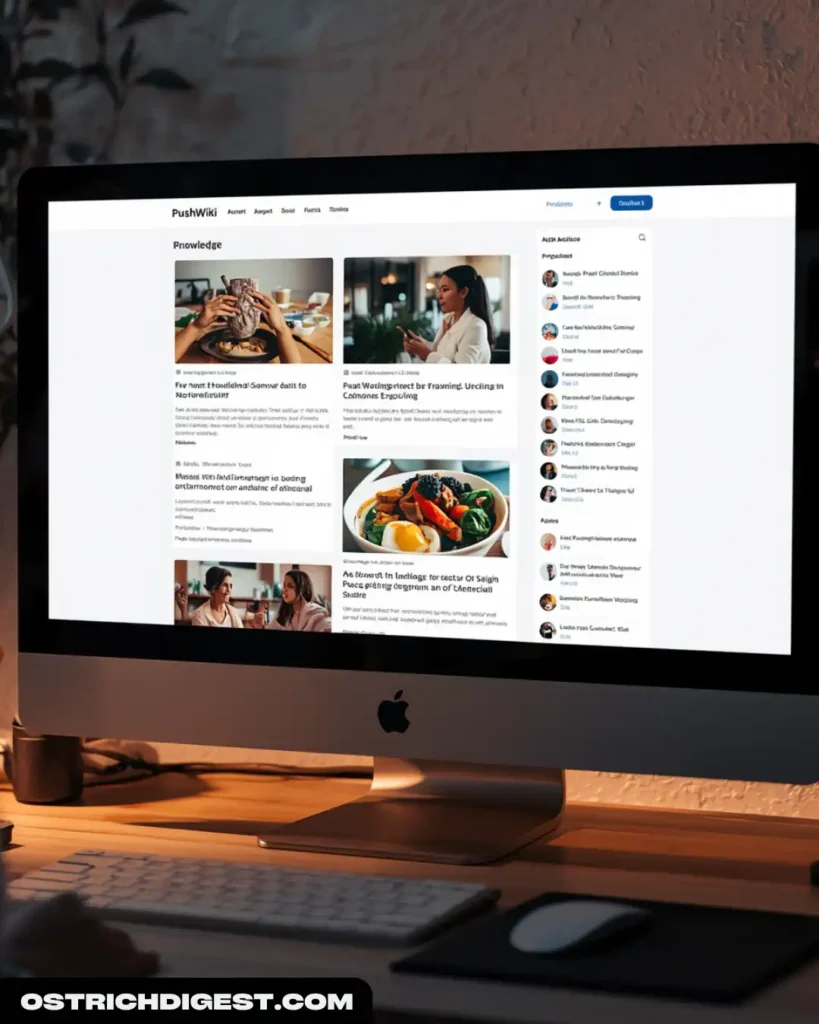
One of the most consistently praised features of PushWiki.com is its clean, uncluttered design. The platform uses a magazine-style layout that feels familiar and comfortable from the first visit, according to AIListingTool. Traditional wikis can overwhelm beginners with dense text and endless hyperlinks. PushWiki.com strips the experience back to what actually matters.
Articles are formatted for readability. Furthermore, headings break content into logical sections. Short paragraphs prevent the wall-of-text problem that plagues many informational websites. Additionally, the site loads quickly, which is an increasingly important factor for mobile readers who abandon slow-loading pages.
Search and Content Organisation
The platform organises topics, provides internal links, and makes content easy to search. Articles are grouped into categories that are accessible from the site’s navigation. According to Ranker Blog, readers can explore featured articles on the homepage or use the search bar to find specific topics.
Furthermore, strong internal linking creates a network of related content. That encourages readers to explore a topic more deeply across multiple articles. That approach mirrors the browsing experience that made Wikipedia popular. However, it applies the model to a more curated and accessible content set.
Social Sharing
According to Ranker Blog, social media buttons make it easy to share articles across platforms like Facebook, Twitter, and Reddit. That sharing infrastructure allows the platform’s content to reach new audiences through recommendation rather than relying entirely on search traffic. Popular articles can consequently spread organically across social platforms when they address timely or widely searched topics.
Community Participation
Like many wiki-style sites, the platform encourages community participation. Users may have the option to contribute content, suggest edits, or share insights. According to Ranker Blog, readers who want to share expertise can submit articles or edits, helping the platform grow with fresh perspectives. However, it is important to note that PushWiki.com is editorially controlled, not fully crowd-sourced. Submissions go through a review process rather than being published automatically.
How Does PushWiki.com Compare to Competing Platforms?
Against Wikipedia
Notably, the comparison with Wikipedia is the most common benchmark readers apply. Wikipedia remains the strongest resource for factual depth, citation density, and comprehensiveness across virtually every subject area. PushWiki.com does not attempt to replicate that depth. Instead, it focuses on accessibility and readability for readers who find Wikipedia’s formatting and citation-heavy style overwhelming.
According to ADAPT Press, PushWiki.com avoids “overly technical formatting and dense citations,” making it easier to read than Wikipedia. That is a genuine differentiator for readers who want quick understanding rather than exhaustive research. However, the trade-off is that PushWiki.com should not be used as a primary source for academic research or professional decision-making.
Against Medium
Medium operates as a publishing platform for personal essays, opinion pieces, and thought leadership. Its content is largely first-person, subjective, and voice-driven. PushWiki.com, by contrast, focuses on informational guides written in a neutral, third-person register. Both platforms are free to read. Furthermore, both cover a wide range of subjects.
Ultimately, the key difference is intent. Medium suits readers looking for perspective, experience, and voice. PushWiki.com suits readers looking for structured, neutral explanations of how something works. Consequently, the two platforms serve different moments in a reader’s information journey rather than competing directly.
Against HubPages and General Knowledge Platforms
HubPages and similar platforms allow large numbers of writers to contribute. That creates volume but introduces significant quality variation. PushWiki.com’s editorially controlled model means quality is more consistent, if also more limited in volume. According to Bitcodesolution, PushWiki.com looks more organised than HubPages in overall structure and content coherence.
Who Is PushWiki.com Best For?
Casual Readers and Students
Notably, the platform suits casual readers who want a quick, clear answer to a general question. Students who need an accessible introduction before engaging with academic material also benefit greatly. Articles are written at a general reading level, use plain English, and avoid jargon that might alienate non-specialist readers.
Students can use PushWiki.com to build foundational understanding before consulting textbooks or academic databases. Its strengths in technology, business, and health make it particularly useful for school and early college students.
Professionals Seeking Quick Overviews
Working professionals who need a rapid explanation of an unfamiliar concept before a meeting represent another strong use case. The business and technology categories, in particular, are well-suited to this kind of professional browse-and-learn behaviour.
Furthermore, HR managers needing employment law basics or project managers encountering new technology categories can use PushWiki.com as a starting point. It is not a definitive reference, but it orients the reader effectively.
Who Should Look Elsewhere
Academic researchers needing peer-reviewed citations should use Google Scholar or PubMed as their primary resources. PushWiki.com works best as an orientation tool rather than a citation source, according to AIListingTool. Medical professionals should rely on clinical databases rather than general health content when making diagnostic or treatment decisions.
Moreover, journalists and researchers needing primary sources or expert attribution should treat PushWiki.com as a background aid at most. The platform does not claim to be an authoritative source, and its readers should not treat it as one.
What Are the Strengths and Limitations of PushWiki.com?
Strengths
Notably, its greatest strength is accessibility. Free access, no login requirement, clean design, and plain-language writing combine to create a genuinely low-friction information experience. Additionally, its breadth across multiple categories makes it a single destination for readers with varied interests. Separate visits to multiple niche sites become unnecessary.
Furthermore, the editorially controlled model is a further advantage. Unlike fully crowd-sourced platforms, PushWiki.com has a baseline quality standard that filters out the most unreliable contributions. Furthermore, the WordPress foundation means the platform is technically stable, loads reliably, and functions consistently across devices and browsers.
Limitations
The platform’s limited scale means it cannot match Wikipedia’s depth or breadth on any specific subject. It is also relatively young, having launched in 2023, so its catalogue of articles is still growing. Moreover, some subject areas are more developed than others. Consequently, readers searching for obscure or highly technical topics may find that PushWiki.com does not yet have relevant content.
The small team behind the platform also means that content production is slower than larger publishing operations. Because the platform is not crowd-sourced, the speed at which errors or outdated information get corrected depends entirely on the editorial team’s capacity. Consequently, that is a meaningful limitation for time-sensitive topics.
FAQs
What is PushWiki.com?
PushWiki.com is a free, content-driven knowledge platform. According to ADAPT Press, it is built to make information clearer, faster, and more accessible for everyone. Topics include technology, business, health, law, travel, and education.
Is PushWiki.com free to use?
Yes. According to Global Publicist 24, the platform requires no login, no subscription, and no payment to read any content. All articles are freely available to anyone who visits the site.
Is PushWiki.com safe?
According to ADAPT Press and XtraSaaS, PushWiki.com presents no obvious red flags and appears to be a legitimate content platform. It uses HTTPS, lists named contributors, and publishes original content with a visible contact presence.
When was PushWiki.com launched?
According to ADAPT Press, the platform has been active since at least mid-2023. It continues to publish new content regularly, with articles appearing as recently as February 2026.
Who writes the content on PushWiki.com?
According to Global Publicist 24, two publicly listed contributors are Devin Haney and Shivi Hyde. The platform is editorially controlled rather than crowd-sourced, meaning contributions go through a review process before publication.
How does PushWiki.com compare to Wikipedia?
According to ADAPT Press, Wikipedia is far larger and more comprehensive. PushWiki.com is smaller and more conversational, with greater accessibility for general readers. Consequently, PushWiki.com suits quick, readable overviews while Wikipedia suits detailed research.
What topics does PushWiki.com cover?
The platform covers technology, business, health, law, travel, and education. According to Bitcodesolution, the Technology and Business sections currently have the largest number of articles. Travel and Law are growing but remain smaller categories.
Does PushWiki.com allow user contributions?
According to Ranker Blog, the platform encourages community participation and allows users to submit articles or suggest edits. However, it is editorially controlled, meaning submissions are reviewed before publication rather than published automatically.
Who is PushWiki.com best suited for?
According to Global Publicist 24, the platform best suits casual readers, students, and professionals who want quick, readable overviews. Academic researchers needing peer-reviewed citations should use specialist databases instead, according to AIListingTool.
Is PushWiki.com better than a niche blog?
According to ADAPT Press, PushWiki.com offers more topical breadth than most niche blogs, which typically focus on a single subject. Its informational, neutral writing style also differs from the personal, opinion-driven content common on general blogs.
Read about Alamance Crossing Movie Theater